I had hallux valgus surgery a few years ago, but it feels like the bunion is coming back out again-if it's a recurrence, is the approach different from the first time?
Key Answer
Recurrent hallux valgus is often not treated by repeating the same osteotomy site and fixation method used in the first surgery.
The priority is to first identify the point where correction was insufficient during the first surgery, or where the joint surface angle itself (DMAA) may have been overlooked.
Depending on where the cause of recurrence is identified, a different procedure is chosen among distal osteotomy, proximal osteotomy, or double osteotomy.
Questions This Article Answers
- Why does hallux valgus recur years after surgery?
- When recurrence occurs, is a different site operated on than in the first surgery?
- Are there tests that must be checked before revision surgery?
- What should be given extra attention during the first surgery to prevent recurrence?
- Can revision surgery also be performed using the minimally invasive MICA method?
I am Dr. Hyuk-Ju Moon, board-certified orthopedic surgeon and Chief Director of Seoul One Hospital.
In my clinic, I regularly see patients from the Hwagok-dong area who had hallux valgus surgery elsewhere a few years ago and now return saying, "I definitely had surgery, but it feels like it's bulging out again."
For these patients, the consultation begins by placing the records from the first surgery side by side with the current deformity angle for comparison.
Why Does Hallux Valgus Recur Years After Surgery?
Recurrence does not necessarily mean the surgery was done incorrectly — in many cases, it is because the correction range at the time of the first surgery was matched only to the deformity as it existed at that point.
Long-term follow-up studies show that after shaft osteotomy, with at least 8 years of follow-up, cases where the preoperative HVA (hallux valgus angle) exceeded 25 degrees had a recurrence rate of about 20%, while milder deformities just over 15 degrees showed lower reported recurrence rates (EFORT Open Rev 2024).
In other words, the more severe the initial deformity, and the less fully the intermetatarsal angle (IMA) or the DMAA — the tilt of the joint surface itself — was corrected, the more room remains for the deformity to widen again years later.
The normal reference range is HVA under 15 degrees and IMA under 9 degrees (Radiographic classification), yet many patients who come in with recurrence present with X-rays that have again exceeded these thresholds.
For Chevron osteotomy, the recurrence rate is reported at about 6.9%, along with complications such as hallux varus (over-correction causing the toe to deviate in the opposite direction) at 4.8% and nonunion at 3.1% (Chevron osteotomy cohort).
When considering revision surgery, these figures are not meant to suggest "the first surgery was wrong," but rather are used as reference data showing what characteristics are shared by the group of patients at risk of recurrence if the same procedure is repeated.
Comparison of recurrence rates by preoperative deformity angle range · 출처: EFORT Open Rev 2024
To determine whether recurrence has occurred, the first step is to re-measure the preoperative angle and the current angle using the same standard (HVA, IMA). I always ask follow-up patients to bring their pre- and post-operative photos from their earlier surgery if they have them.
Why Consider a Different Osteotomy Site When Recurrence Occurs?
The reason the osteotomy site is changed in revision surgery is to re-identify the "true location" of the deformity that the first surgery failed to correct.
For example, if the first surgery was a distal (toe-side) osteotomy and recurrence occurred, it is necessary to re-examine whether the underlying cause was actually a proximal deformity where the metatarsal itself was splaying.
I once treated a woman in her 60s whose pain was so severe she had become unable to exercise and even experienced depression as a result; in her case, the first metatarsal's distal joint surface angle (DMAA) was large, and a single osteotomy alone would have been difficult to correct, so I used a double osteotomy approach to avoid creating a zigzag deformity.
Recurrent hallux valgus requires a similar thought process. Without comprehensively evaluating the degree of subluxation at the metatarsophalangeal joint, the length of the first metatarsal, and instability at the tarsometatarsal joint, revision surgery can also lead to another recurrence.
The fact that correction with braces or orthotics in the first surgery is limited to only about 2–3 degrees per month (PMC8375760) and cannot reverse the deformity itself is also the basis I use to explain to recurrence patients that non-surgical reinforcement alone has its limits.
Revision surgery does not mean "cutting the same spot again" — it begins with "re-identifying where the axis of the deformity actually originated." At Seoul One Hospital, we retake a full-foot X-ray for returning patients and compare it with the images from the first surgery to determine whether distal, proximal, or double osteotomy is appropriate for the current deformity.
Step-by-step process for reassessing the cause of deformity before revision surgery for r…
What Should Be Checked Before Revision Surgery, and When Are Non-Surgical Options Appropriate?
Before deciding on revision surgery, I always first check how much range of motion the first metatarsophalangeal joint has.
If the big toe joint does not move at all and cannot be bent upward — a condition called hallux rigidus — a different surgical approach is needed rather than a simple osteotomy.
Self-Check Checklist
- Is the pain after recurrence severe enough to interfere with daily walking?
- Has the pain failed to improve even after changing shoes and trying pads or orthotics?
- Does the big toe joint feel stiff or make a clicking sound?
- Has new callus formation or pain developed under the ball of the big toe (metatarsal head) when walking?
- Does it feel like the deformity is spreading to the other toes as well?
Warning Signs: If the skin on the big toe is cracking or a wound is not healing well, and especially if the patient has diabetes, there may be combined blood flow and sensory issues, so immediate medical evaluation is recommended. Delayed wound healing after surgery is generally reported at about 2–4% (PubMed Central), and this is a point of greater concern in revision surgery since the tissue has already been incised once.
When It's Not Appropriate: If the recurrence involves no pain and only cosmetic concerns, I do not recommend surgery. The fact that surgery is generally not recommended for asymptomatic cases or for cosmetic purposes alone (PubMed Central) is the standard that determines whether revision surgery is warranted, and it is the same standard I apply when recommending a first surgery as well.
If there are no clear warning signs and the pain is mild, we do not recommend immediate revision surgery and instead observe the progression first.
| Category | Initial Surgery | Revision Surgery After Recurrence |
|---|---|---|
| Evaluation criteria | Focused on current deformity angle | Comparison of initial surgical records with current angle |
| Osteotomy site | Focused on primary deformity site | Re-examination among distal, proximal, and double osteotomy |
| Joint surface evaluation | Evaluation including DMAA | Re-confirmation of DMAA, subluxation, and joint stiffness |
| Recovery plan | Standard weight-bearing plan | Adjusted in stages considering soft tissue condition |
How Does Seoul One Hospital Near Hwagok Station Treat Recurrent Hallux Valgus?
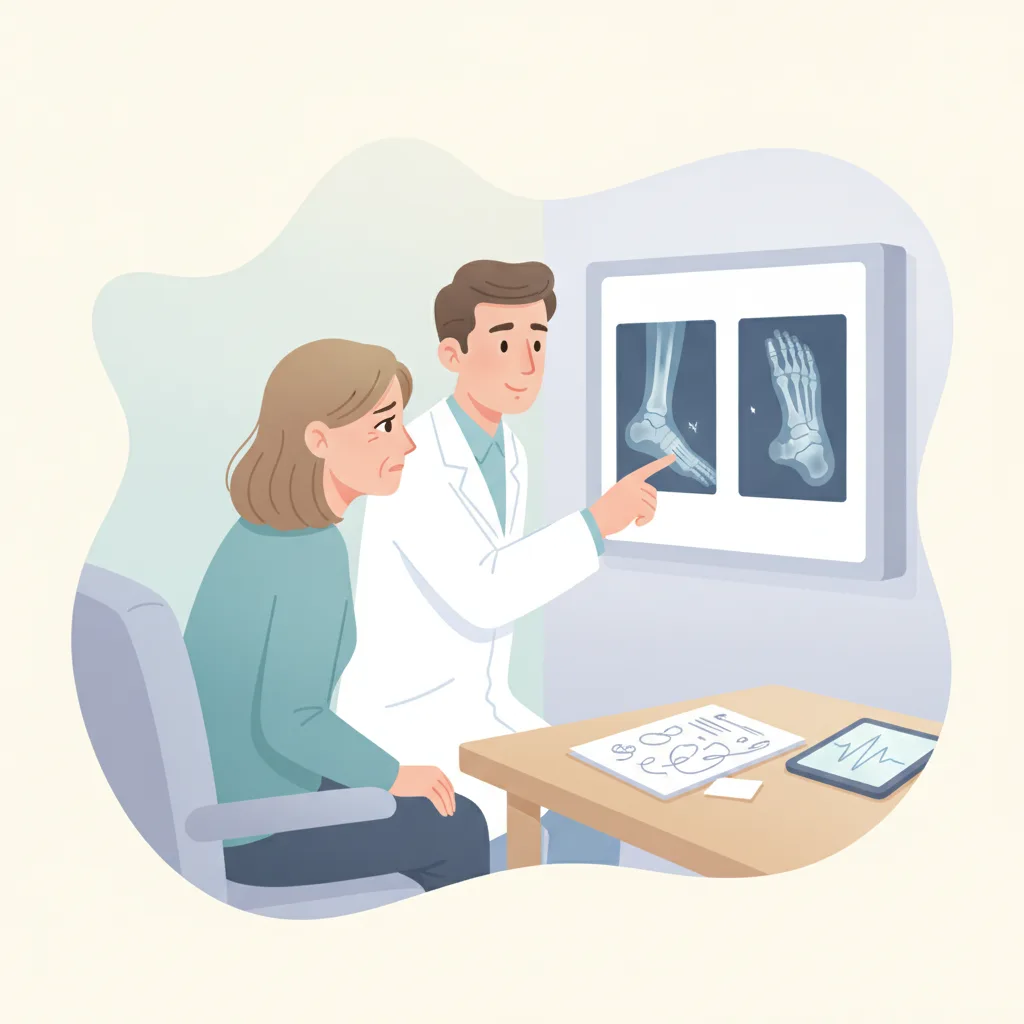
Care for recurrent hallux valgus begins with comparing the records from the first surgery with the current deformity via X-ray.
When I see a recurrence patient, regardless of which hospital performed the first surgery, I begin by reassessing the current state of the foot as if seeing it for the first time.
I conduct this reassessment of recurrent deformities drawing on my experience treating adult foot and ankle conditions alongside pediatric orthopedics at our Foot Center, as well as my background establishing one of the first independent specialty clinics for adult foot and ankle conditions at Seoul National University Hospital.
As of August 2024, Seoul One Hospital's cumulative experience in foot and ankle surgery stands at 4,827 cases, which includes cases of patients who returned for care due to recurrence.
If revision surgery is determined to be necessary, the basic approach of correction through osteotomy is maintained, but depending on the condition, a minimally invasive MICA bunion correction approach using a smaller incision is also considered.
Hospitalization averages 1–2 weeks, the procedure takes about 1 hour under spinal anesthesia (or general anesthesia depending on the patient's condition), and after discharge, patients are advised to avoid soaking baths until stitches are removed, with driving to resume only after the attending physician's approval.
I try to explain things in terms that are easy for patients to understand rather than using difficult medical terminology, and for recurrence patients in particular, I explain using images showing "what the previous surgery addressed, and what we are looking at this time."
Whether revision surgery is needed is determined by placing the records from the previous surgery alongside the current X-ray and re-identifying the location where the deformity occurred.
Frequently Asked Questions
How long after surgery does recurrence typically appear?
Individual variation is significant, but long-term follow-up studies use data tracked for at least 8 years as a recurrence rate indicator. In many cases, the angle gradually widens again over the course of several years, so regular X-ray follow-up is necessary even after surgery.
Why does revision surgery feel more complicated than the first surgery?
This is because the condition of tissue and bone that was already incised must be taken into account, and the site causing the deformity may differ from the first time. Therefore, a reassessment process is needed first to determine whether distal, proximal, or double osteotomy is the appropriate approach.
How long does recovery take after revision surgery?
Bone union at the osteotomy site takes about 6–7 weeks, and return to daily activities or light activity is often indicated at around 6–12 weeks after surgery (NCBI). Revision surgery may be planned more conservatively than this depending on the condition of the soft tissue.
Who should patients worried about recurrence see first?
The priority is to receive a comparative X-ray evaluation from a board-certified orthopedic surgeon who can review the records (angle and procedure) from the first surgery. If the concern is purely cosmetic with no pain, there is no need to rush into a decision about revision surgery.
Key Takeaways
- Recurrence of hallux valgus is often not due to an error in the first surgery, but rather a re-emergence of the deformity's true underlying location.
- Revision surgery is chosen by reassessing which approach — distal, proximal, or double osteotomy — matches the current angles (HVA, IMA, DMAA).
- For recurrence involving only cosmetic concerns without pain, observation is recommended before considering surgery.
- Before revision surgery, it is essential to compare the records from the first surgery with the current X-ray to re-identify the site causing the deformity.
Chief Director Dr. Hyuk-Ju Moon, board-certified orthopedic surgeon, completed his orthopedic residency at Seoul National University Hospital and currently treats adult foot and ankle conditions at Seoul One Hospital's Pediatric Orthopedics and Foot Center. Profile
Seoul One Hospital is located a 1-minute walk from Exit 8 of Hwagok Station (Seoul Subway Line 5) (Dongmyeong M Building, 179 Gangseo-ro, Gangseo-gu, Seoul), and parking is available on basement levels 1 and 2 behind the building.
If you suspect a recurrence, bringing records from your previous surgery (X-rays if possible) when you visit will make the comparative evaluation easier. Please contact us at 1544-5888 for guidance.